Self-determination, the principle of harm and the limits of criminalisationECHR Article 8, modern autonomy thinking and the state's burden of justification – with substance use as the case
- marcuscostagaaseid
- 15. mai
- 58 min lesing
Oppdatert: 18. mai
Merk: Artikkelen er fortsatt til fagfellevurdering, derav den gule uthevede teksten der sidehenvisning ikke er inntatt.
About The Author
Marcus Costa Gåseide is a legal advisor with a license to practice law and works as an adviser in the Ministry of Transport and Communications, where he works with, among other things, legislative and regulatory work in railway, cable car and amusement park law, EEA law issues and appeals. He has a master's degree in law from the University of Bergen with a specialization in tax and company law and has previous experience from both the legal industry and the municipal sector.
Executive Summary
he article’s main thesis is that developments under Article 8 of the European Convention on Human Rights do not necessarily render the criminalisation of drug use unlawful, but that they do intensify the state’s burden of justification when criminal law is used against private conduct between consenting adults. The point of departure is a methodological question: what reasons must a modern constitutional democracy be able to provide when intervening against conduct that takes place within the private sphere between consenting adults? The author uses drug use as a case study, but the framework is broader and concerns the relationship between autonomy, privacy, morality, and the legitimate use of state power in European law. Methodologically, the article combines doctrinal analysis of Article 8 ECHR and Norwegian law with legal historical, legal philosophical, and criminal policy perspectives.
The central argument is threefold. First, it is argued that Article 8 ECHR and Section 102 of the Norwegian Constitution shift the analysis from moral governance to justificatory governance. Second, Dudgeon v. United Kingdom and Laskey, Jaggard and Brown v. United Kingdom are used as methodological reference points: morality alone is insufficient, whereas concrete and qualified harm may justify state interference. Third, Norwegian drug policy, the Drug Reform Committee report, the Norwegian Supreme Court’s 2022 case law, and the Role Understanding Committee’s report demonstrate that the current model both relies upon and produces harm, including through stigma, control, registration, and secondary legal consequences. The conclusion is not a demand for unrestricted legalisation, but rather a demand for more precise, proportionate, and evidence based regulation, in which the state must explain what harm is to be prevented, why criminal punishment is a suitable means, and why less intrusive measures are insufficient.
Foreword
I would like to extend a big thank you to Professor of Property Law at the University of Bergen (UiB), Hans Fredrik Marthinussen, my former colleagues Christoffer Olav Hernæs, Marta Trzcinska Slinde, Ella Stormo, Mahintan Alonso Markandu, Thor With, Frøydis Eidissen and Rune Holsen Nygård, former fellow student Svein Harald Dyngen, my friends Synnøve Orvik, Ingrid Rambech, Kristian Riksheim and Adrian William Langburne, as well as the wife of my cousin, Elin Modahl Røstad, for good professional input, reflections and inspiration during the work on the article. A big thank you also to the other lecturers at UiB. I would also like to thank my family for their support, patience, and encouragement throughout the process.
This article is basically about whether states can punish people for the use of illegal drugs (i.e. "narcotics" according to old doctrine), or subject them to torture, inhuman or degrading treatment as a result of such use. If Article 8 is to be taken seriously, it must make real demands on the precision of the justifications. Nevertheless, the article is actually about something much more important: how modern European constitutional states justify the exercise of power over the individual. It is about what actually happens when the state intervenes in people's private lives, and what justifications are currently considered legitimate when criminal law is used against autonomous adult behavior.
Large parts of European legal history can be described as the history of the state's attempts to regulate the human body, sexuality, religion, morality and personal life. In this story, the law has not only functioned as protection against harm. Unfortunately, it has also functioned as a cultural project, morality steward, and discipline mechanism.
The article is written with the support of our own creativity as well as artificial intelligence ("AI") as a work and structure tool, more specifically ChatGPT (the latest version available). AI has been used for idea development, systematization and linguistic processing throughout the process. The final check of sources, legal assessments and academic design must nevertheless be at the author's expense.
Keywords: Legal history, philosophy of law, human rights, criminal law, drug policy, privacy, democracy and self-determination
1. Introduction and background
A man sits alone in his own apartment. He hasn't hurt anyone. He has not driven a car. He has not committed violence. He has not sold illegal drugs. Nevertheless, the state can intervene with searches, registrations, fines, imprisonment, coercive measures and other negative actions.
In another case, two adult men sit alone in a private home and have sexual intercourse. No third person is involved. No one is subjected to coercion. Nevertheless, until quite recently in European legal history, the state believed that sex between consenting men could be criminalized.
The first example describes modern drug legislation. The second describes the situation in Case No. 7525/76 before the European Court of Human Rights ("ECtHR") of 22 October 1981, namely Dudgeon v. United Kingdom. The Dudgeon case concerned the criminalization of homosexual acts between adult men in Northern Ireland. The point is not that homosexuality and drug use necessarily are comparable phenomena. The methodological point is that both types of cases raise the question of what justifications the state must be able to demonstrate when criminal law is used against private adult behaviour.
At first glance, the comparison may appear both methodologically weak and provocative. Homosexuality and substance use are not the same thing. Homosexuality does not in itself entail medical or societal harm. Substance use, on the other hand, can be linked to addiction, overdoses, mental disorders, violence, neglect and significant socio-economic costs.
Nevertheless, both situations raise a more fundamental question: When the state uses criminal law against choices presumably adults make in order to feel good, what justifications must the state be able to show?
The article examines whether developments under Article 8 of the ECtHR entail stricter requirements for the state's justification for criminalising private adult behaviour, using Norwegian drug policy as an example. The central question is not whether the state can regulate drugs, but what requirements human rights impose on necessity, proportionality and legitimate justification when criminal law is applied to acts that take place in the private sphere between consenting adults.
Methodologically, the article combines legal dogmatic analysis of Article 8 of the ECHR and Norwegian law with legal history, legal philosophy and criminal policy perspectives
1.2 Drugs and drugs as concepts
The term "intoxication" is difficult to define precisely, precisely because the phenomenon lies in the borderland between biology, psychology, culture and society. In a legal context, the term is often used relatively functionally, often for states where consciousness, mood, ability to react or perception are affected by chemical substances. However, such a definition quickly becomes too narrow. Human experience is continuously influenced by a variety of stimuli: food, sleep, sexuality, social belonging, physical activity, caffeine, nicotine, and emotional experiences can all alter mood, energy, perception, and behavior.
This raises a more fundamental question: What exactly is it that distinguishes intoxication from other forms of human pleasure or consciousness?
One possible difference lies in the intensity and direct chemical impact of the central nervous system. Drugs are often characterized by the fact that they relatively quickly and purposefully affect the brain's reward systems, sensory experience or state of consciousness. At the same time, the line is far less sharp than one might first think. Alcohol is socially accepted despite the influence of consciousness (which can be quite strong). Caffeine is used almost universally to regulate energy and concentration. Sugar and ultra-processed foods also affect the brain's reward systems in ways that some researchers have compared to milder forms of addiction mechanisms (cravings, habit formation and short-term energy peaks).
The difference between intoxication and other forms of pleasure is therefore not only biological, but also cultural and historical. Societies categorise certain forms of consciousness as legitimate and others as illegitimate. Wine for dinner is perceived fundamentally differently from cannabis, even though both involve chemical mood. This does not mean that the differences are irrelevant. According to common medical teaching, drugs can entail a far greater risk of addiction, mental illness or loss of function than ordinary food or everyday stimulants. Rather, the point is that the distinction between "normal" pleasure and "intoxication" is not natural alone, but also shaped by culture, tradition and political choices.
Precisely for this reason, the field of substance abuse becomes methodologically interesting from a human rights perspective. When the state regulates drugs, it regulates not only chemical substances, but also certain forms of human experience, mood change and escapism. This makes the question of regulation more difficult in principle than a pure question of poison control or medical injury prevention. In the background there is also a more existential question: To what extent should the state be able to control how people choose to influence their own consciousness?
The term "narcotics" is a legal and regulatory concept. In Norwegian law, it refers to substances that are classified as "narcotics" (illegal drugs) through the Narcotic Drugs Regulations, and which are thus covered by the criminal law rules in the Medicines Act and the Penal Code, among others. What is considered a drug is therefore not only a medical question, but also a result of political and legal classification choices.
The term "illegal drugs" is broader and more descriptive. It generally refers to drugs that are prohibited under current law, without necessarily attaching the same legal or historical content to the word "narcotics". Some people therefore prefer the term «illegal drugs» because it can be perceived as more precise and less normative, especially in academic and human rights analyses where one wants to discuss regulation and autonomy without the use of the term itself signalling moral or criminal condemnation to an excessive extent.
1.3 The place of intoxication in human history
Drugs and consciousness-altering substances have followed humans throughout much of our history. Alcohol, fermented beverages, hallucinogenic plants, opium, cannabis and various forms of ritual or medicinal drugs are documented in a number of cultures far back in time. This makes the field of drugs interesting in principle also on a deeper anthropological level: Drugs do not appear as a modern deviation from human nature, but rather as a recurring feature of human culture. By "anthropological" we mean the study of people, culture, society and human behaviour.
Archaeological finds indicate that humans produced alcoholic beverages thousands of years before the Common Era. Throughout history, intoxication has been linked to religion, rituals, community, mourning, celebration, art, sexuality and social belonging. Around campfires, in ceremonies, during religious rituals and in collective rites of passage, drugs have often functioned as something more than just stimulants. They have also been linked to experiences of community, transcendence and altered consciousness. "Transcendence" here means an experience of transcending the ordinary, everyday or purely material, often linked to strong emotional, spiritual or consciousness-altering experiences.
This does not mean that intoxication is necessarily positive or harmless. On the contrary, history also shows extensive harmful effects related to addiction, violence, illness and social disintegration. Nevertheless, the long historical continuity illustrates that man's relationship to substance abuse is more complex than the notion of a purely modern social problem.
Some researchers and cultural theorists have also raised the question of whether consciousness-altering substances may have influenced human creativity, symbolic thinking and cultural development. The hypotheses in this area are controversial and partly speculative, but they are based on the observation that drugs in many cultures have been linked to artistic, religious and philosophical experiences. Altered states of consciousness can in some cases contribute to associative thinking, emotional intensity and experiences of new perspectives or insights.
However, it would be methodologically indefensible to claim that intoxication "created" civilization or human intelligence. Human development is due to an interaction between language, cooperation, technology, social organization, the environment and biological evolution. At the same time, it is difficult to ignore the fact that drugs throughout history have been closely linked to some of man's most fundamental cultural experiences: the desire for community, ecstasy, escape, meaning, creativity and transcendence of everyday consciousness.
That is precisely why modern drug policy also becomes methodologically demanding. The state regulates not only chemical substances, but also forms of human experience that have existed in various forms throughout large parts of our history. This does not mean that every drug should be accepted or liberalized. But it challenges the notion that intoxication alone can be understood as an alien element that can be eliminated through criminal control. Rather, history suggests that man's relationship with intoxication is deeply rooted in culture, psychology and social life – and that the issue of regulation can therefore hardly be solved through prohibition alone.
1.4 Consequences of the at least 55-year-old «war on drugs»
A natural historical turning point in modern drug policy is the development of the United States under President Richard Nixon in the early 1970s. In 1971, Nixon declared "drugs" " public enemy number one" and began what later became known as the War on Drugs. Although drug regulation existed long before this, the Nixon period represented an important shift both rhetorically, politically and institutionally. The drug problem was increasingly portrayed as a question of race, crime, security and social control rather than primarily as a health or social policy issue.
This approach had enormous international ripple effects. Through American foreign policy, international conventions and global political influence, the punitive model was exported to large parts of the world. European countries, including Norway, also gradually developed stricter criminalisation regimes in line with this development. The modern drug policy can therefore hardly be understood without the political and cultural influence of the American "war on drugs".
At the same time, the consequences have been extensive and deeply controversial. Internationally, the global drug war has contributed to mass incarceration, militarization of police work, violent illegal markets and considerable human suffering. In the United States, the policy hit particularly poor areas and minority communities hard, with major social and economic consequences over several generations. In Latin America, the international war on drugs contributed to the emergence of extremely violent cartel structures, corruption and the widespread destabilisation of local communities and state apparatuses.
The consequences have also been significant at the individual level. Over the decades, millions of people have been faced with imprisonment, social marginalization and lasting stigma for actions related to drug use and possession. At the same time, overdose deaths, addiction and illegal markets have largely continued to exist, despite the massive use of criminal justice measures. Precisely this has led to growing international criticism of whether the traditional "war on drugs" has actually achieved its stated goals, or whether it has significantly produced new forms of harm and suffering.
From a human rights perspective, this is particularly interesting because the development illustrates how criminal policy is not only about the regulation of drugs, but also about the state's understanding of social control, risk and legitimate use of force. The war on drug use was largely built on the notion that ever harsher punishments would reduce demand and protect society. However, the experience of the past fifty years has made it increasingly difficult to maintain the notion that punishment alone can solve complex social, medical and human problems, which the Drug Reform Committee also concluded, see section 2.1 below.
2 Norwegian drug regulations
Norwegian and international drug policy can hardly be understood without another brief look back. The first modern Norwegian legal provisions against illegal drugs did not arise primarily as a result of a broad domestic political debate on personal autonomy or the limits of criminal law, but as part of an international development after the Second World War.
Through the UN conventions in the 1960s, drug policy became increasingly internationalised, and Norway also gradually moved from a relatively limited regulatory model to an increasingly strict criminalisation model. The 1960s and 1970s in particular were characterised by a strong fear of heroin, youth environments and social disintegration. The drug problem was largely understood as a question of crime, moral decay and social protection.
This development must also be seen in the light of the spirit of the times. The post-war period was characterized by a strong belief in social governance, expert control ("technocracy") and state regulation. In Norway, this was combined with a broad social democratic notion that the state could and should intervene actively to protect society from what was then considered to be destructive developments.
Criminal law thus became not only a means of reaction to specific harms, but also a tool for norm formation and preventive governance. During the 1980s and 1990s, Norwegian drug policy was further tightened, including through stricter penalties, expanded coercive measures and strong political rhetoric about the "fight against drugs". At the same time, an increasingly clear tension emerged between the health perspective and the punishment perspective.
From the end of the 1990s and especially into the 2000s, however, several developments began to challenge the traditional model. Overdose deaths, marginalisation and heavy burdens on user groups led to increased criticism of a policy that had largely been built around criminalisation. At the same time, several European countries developed alternative models, including Portugal's decriminalisation reform from 2001. The international debate gradually moved from a one-sided focus on punishment to issues of harm reduction, health and social integration.
2.1 Norwegian drug policy is changing – from morality and punishment to health and harm reduction
Norwegian drug policy has traditionally been built on a combination of the health perspective and the punishment perspective. On the one hand, illegal drugs were understood as a serious health and social problem. On the other hand, criminal law was considered a necessary instrument to limit use, reduce availability and mark society's distance from illegal drugs. Especially from the 1960s and 1970s, an increasingly strict drug policy developed, both in Norway and internationally, where criminalisation was given a central place.
At the same time, this development must be understood in light of the broader legal culture and international context. The post-war period was characterised by a strong belief in state control, social control and universal welfare models. Criminal law was not only used to respond to specific injuries, but also as an instrument for shaping social development. Drug policy thus became closely linked to notions of social order, security and protection of the community.
From the end of the 1990s and especially into the 2000s, several developments began to challenge this model. Overdose deaths, marginalisation and heavy burdens on user groups led to increased criticism of a policy that had largely been built around criminalisation. At the same time, several European countries developed alternative models, including Portugal's decriminalisation reform from 2001. The international debate gradually shifted from a one-sided focus on punishment to issues of harm reduction, health and social integration.
Nor did the development in Norway suddenly come with the Drug Reform Committee in 2018. The attempt to move parts of drug policy from the punitive track to the health and social track has in reality been going on for several decades. The drug reform in 2021 was therefore not the first attempt at a fundamental restructuring of Norwegian drug policy, but rather the third major reform track in modern times.
The first reform track came through harm reduction-oriented measures from the 1990s and throughout the 2000s. Here, arrangements were gradually established such as injection rooms, medication-assisted rehabilitation (OMT), distribution of clean user equipment and a more health-oriented approach to heavy user groups. These measures did not entail an end to criminalisation, but nevertheless represented an important shift in legal policy. The state began to regard drug addiction to a greater extent as a health problem rather than exclusively a crime problem.
The second reform track came through the gradual legal and political criticism of criminal law reactions to users and drug addicts. In the 2010s in particular, the proportionality of fines, arrests, urine tests and coercive measures in user cases was increasingly problematised. The debate also took on a human rights dimension through questions of privacy, stigma, marginalisation and trust in the support system. This development formed much of the backdrop for the work of the Drug Reform Committee.
The third and most extensive reform attempt came with the Drug Reform Committee, which was appointed in 2018 and submitted NOU 2019:26 Rusreform – fra straff til hjelp. The Commission did not propose legalisation of illegal drugs, but recommended that the use and possession of small quantities of illegal drugs for personal use should no longer be met with criminal sanctions. Instead, the reaction was to be moved to a health-oriented and administrative track.
The committee was based on arguments about harm reduction, proportionality, stigma and the need to strengthen trust between user groups and the support system. At the same time, the Commission emphasised that illegal drugs should continue to be illegal, and that sales, production and organised crime should continue to be met with criminal sanctions.
The drug reform debate thus clearly illustrates the broader development this article discusses: the transition from moral- and discipline-oriented regulation to a more justification-oriented model where the state must legitimize to a greater extent why punishment is necessary. The conflict is therefore not just about drugs. It is also about the type of autonomy that modern European constitutional states are actually willing to tolerate, and what justifications are considered sufficient when the state intervenes in the individual's private life.
2.2 The last of three attempts at drug reform in modern times
In Norway, this development culminated in the Drug Reform Committee, which was appointed in 2018 and submitted NOU 2019: 26 Rusreform – fra straff til hjelp. The Commission did not propose legalisation of illegal drugs, but recommended that the use and possession of small quantities of illegal drugs for personal use should no longer be met with criminal sanctions. Instead, the reaction was to be moved to a health-oriented and administrative track. The committee was based on arguments about harm reduction, proportionality, stigma and the need to strengthen trust between user groups and the support system. At the same time, the Commission emphasised that illegal drugs should continue to be illegal, and that sales and organised crime should continue to be punished.
A key starting point for the Drug Reform Committee in NOU 2019:26 Rusreform – fra straff til hjelp was the principle of harm reduction. Harm reduction is based on the recognition that substance use and addiction cannot be fully eliminated through prohibition and punishment alone, and that policy must therefore also seek to reduce the health, social and human harmful effects that result from substance use and from the regulatory model itself. The perspective does not necessarily imply acceptance or normalisation of the use of illegal drugs, but a pragmatic approach where the goal is to reduce overdoses, disease, marginalisation and loss of life and health. This mindset is also behind measures such as injection rooms, medication-assisted rehabilitation (OMT), distribution of clean user equipment and naloxone programs. In the NOU 2019:26 Green Paper, harm reduction was also linked to issues of dignity, proportionality and trust between user groups and the support system. The Committee emphasised that criminal sanctions could in some cases contribute to increased stigma and social exclusion, and thus counteract the health policy goals the state wanted to achieve. My personal opinion is that, given the current regulations, criminal sanctions should be reserved for the most serious violations.
A concrete result of the more health-oriented approach after the drug reform debate in 2021 was the proposal for a so-called "good Samaritan" rule (the "Samaritan Act"). The idea was that people who call health personnel or emergency services in the event of an overdose or other acute substance-related situations should be less likely to risk prosecution for their own use or possession of small amounts of drugs. The background was particularly the fear that people avoided contacting help for fear of the police and punishment. Although the original drug reform fell politically, the debate and the subsequent legal and political changes contributed to a clearer shift towards harm reduction, proportionality and a stronger health perspective in encounters with users of illegal drugs.
However, the political debate that followed in 2020 and 2021 became far more polarised than the NOU itself. The reform gradually developed from being a question of the relationship between punishment and health to becoming a broader symbolic political issue of "strict" versus "liberal" drug policy. Nuances largely disappeared from the debate. The proposal was presented by many as a step towards legalisation or as an expression of a significant liberalisation of Norwegian drug policy", despite the fact that the Commission explicitly maintained the prohibition model.
In practice, the consultation round after NOU 2019:26 developed into something far larger than an ordinary legal or health policy consultation. Formally, the question was relatively limited: whether the use and possession of small amounts of illegal drugs for personal use should continue to be met with criminal sanctions, or whether the sanction should be moved from the criminal track to a health and follow-up track. In reality, the hearing quickly became a broad and rather superficial battle of principles about the identity of the entire Norwegian drug policy.
A number of prominent professional communities supported the main thrust of the reform. This applied to large parts of the health service, user organisations, several legal environments and actors who worked closely with drug addicts. Many of these emphasised that criminalisation could contribute to stigma, marginalisation and reduced trust in the support system. Several also emphasised that punishment had a limited documented effect on patterns of use, while the reactions could have significant social consequences for young users.
At the same time, considerable resistance arose early on, particularly from parts of the police, the prosecuting authority and some professional communities in the field of substance abuse treatment and prevention. The criticism was complex. Some believed that the reform underestimated the harm potential of illegal drugs. Others feared that decriminalisation would send a signal of normalisation and thus contribute to increased use. Particular attention was paid to concerns about young people, recruitment and weakened overall preventive efficacy.
What is methodologically interesting, however, is how the debate gradually shifted. Instead of a relatively precise discussion about criminal law sanctions, the hearing developed into a more emotionalised and symbolic debate about society's attitude to illegal drugs as such. Several consultative comments and public debates thus moved away from the specific question of the proportionality of punishment through use and possession for personal use, and towards broader notions of moral signals, dissolution of norms and society's "fight against drugs".
As a result, the distinction between decriminalisation, legalisation, regulated sales and full liberalisation was often blurred in the public debate, despite the fact that the Drug Reform Committee expressly maintained the prohibition model and still wanted punishment against sales and distribution.
A distinction is often made between four main models in drug policy. Criminalisation means that use, possession, sale and production are illegal and can be punished with fines or imprisonment. Decriminalisation means that use and possession for personal use are no longer punished, but that the substances are still illegal and that sale and production are still punished. Legalisation means that the state allows certain drugs within a legal and regulated market, often with age limits, taxes and control schemes, as is known from alcohol and tobacco. Between these extremes, there are also various regulatory and harm reduction models, where the state still restricts accessibility, but tries to reduce harm through health follow-up, administrative reactions, controlled sales or medical access rather than traditional punishment.
After the drug reform fell in 2021, the political development continued through the so-called drug settlement in the Storting. The settlement entailed, among other things, a certain relaxation in the use of sanctions for people with substance abuse problems, clearer guidelines on proportionality and increased emphasis on health-related follow-up rather than traditional punishment. At the same time, the main lines of the prohibition model were continued. The drug settlement thus illustrates how Norwegian drug policy has increasingly moved towards an intermediate model where criminalisation is formally maintained, while the level of reaction and control practices are gradually moderated
In several ways, the consultation process thus illustrated a fundamental feature of criminal law: punishment functions not only as practical regulation, but also as moral and symbolic communication. When punishment is proposed to be abolished, this is perceived by many not only as a technical adjustment of forms of reaction, but as an expression of a change in society's moral standpoint.
Precisely for this reason, the role of the police also took on a special importance in the debate. Some police communities argued strongly that the threat of punishment and coercive measures was necessary in order to be able to intervene at an early stage against young people and vulnerable groups. At the same time, considerable criticism emerged of parts of the police's practice, particularly related to the use of coercive measures, urine tests and searches of young people. The debate about limits on legality, proportionality and human rights was thus increasingly intertwined with the broader drug reform discussion.
When the reform finally fell politically in 2021, it was therefore not due to a single legal objection or one crucial professional report. Rather, the process appears as an example of how criminal policy is shaped at the intersection of professional knowledge, symbolic politics, institutional self-understanding, media dynamics and political risk management.
On a deeper level, the hearing also illustrated how difficult it is for modern democracies to discuss criminal law in principle when the issues simultaneously touch on fear, morality, children, identity and society's self-understanding.
At the same time, the debate illustrated a more general feature of modern criminal policy: Criminal law has strong symbolic power. When punishment is removed, this is often perceived not only as a legal change, but as a moral signal. That is precisely why the reform became politically difficult. Several parties gradually moved away from the reform proposal as the public debate intensified, especially in the period leading up to the parliamentary election in 2021. Another important development was the Role Understanding Committee, which was appointed after considerable debate on the police's practice in less serious cases of illicit intoxication.
The Committee assessed, among other things, the relationship between the police's control activities, the principle of legality and the legal protection of citizens. The background was criticism of extensive use of coercive measures, searches, mobile phone searches and urine samples in cases concerning use and possession for personal use, especially against young people. The debate illustrated how drug policy is not only about which actions are criminalized, but also about what forms of control the state uses to enforce the prohibition. The work of the Role Understanding Committee thus raised fundamental questions about proportionality, the use of force and the role of the police in dealing with vulnerable groups in a modern state governed by the rule of law.
The Role Understanding Committee's report Police and Role Understanding from 2022 reinforces this picture. The committee was appointed to assess the relationship between the police and the Norwegian Narcotics Police Association (formerly «NNPF», now the Norwegian Narcotics Prevention Association (NNF). The committee concluded that there had not been a sufficient distinction between the role of the police and the role of a member of the association. The Committee also pointed out that the relationship between the police and the association had been close, and that the association had carried out competence enhancement, prevention of the use of illegal drugs and drug policy activities in one and the same organisation with the police's acceptance, support and encouragement. This is important because it shows that drug policy is not only shaped through the legislature and the courts, but also through institutional practices, professional culture and informal authority structures in the control apparatus. When the police's role as law enforcers slips into influence on drug policy, the question of punishment and coercive measures becomes at the same time a question of the rule of law's understanding of the role of the state, the distribution of power and democratic control.
In the end, what was decisive was not primarily a new legal analysis of proportionality or human rights, but rather political risk management, fear of appearing "soft" in drug policy, and a broader form of significant political consensus formation under very strong media pressure where few wanted to stand alone in an increasingly emotionalized debate.
This is methodologically interesting also from a human rights perspective. If criminal law is upheld in practice because it has symbolic or moral value, rather than because the state can demonstrate concrete and proportionate justifications for harm, precisely the type of legitimacy issues that modern autonomy and human rights thinking seeks to highlight arise.
3. Criminal law as a legitimized exercise of power
Criminal law represents one of the state's most intrusive instruments. Through punishment, the state can deprive the individual, fine, register and stigmatize the individual. Criminal law thus differs from large parts of the rest of public law in that it expresses society's strongest formal condemnation of an act.
3.1 The principle of consequences of harm as a justification for punishment
A key theoretical reference in modern discussions of criminalisation is the harm principle, particularly formulated by the English philosopher John Stuart Mill in On Liberty from 1859. At its core, the principle expresses that state coercion and punishment can only be legitimized to prevent harm to other people. As a starting point, the individual should be free to live his or her life as he or she wishes, even if the actions appear unwise, immoral or self-destructive, as long as they do not cause harm to others.
Mill formulated this through the well-known thesis that "the only purpose for which power can be rightfully exercised over any member of a civilized community, against his will, is to prevent harm to others". The point was not that the state could never intervene, but that intervention required a certain type of justification. Morality, discomfort or the disapproval of the majority were not sufficient on their own, according to Mill. The state had to be able to demonstrate actual harm or risk of harm to others.
The consequential principle has since gained a central place in modern criminal law theory, particularly as a limitation on criminalisation. The principle does not function as a positive rule of law in Norwegian law, but as a fundamental legal philosophical and criminal policy ideal for when punishment should be used. A positive rule of law is a rule of law that actually applies as binding law in a legal system, for example through laws, regulations or case law. In modern criminal law, the principle of consequential harm is often used as an argument that punishment should only be used where actions entail or create a risk of harm of a certain degree of severity.
At the same time, the principle has never been exclusive in the European legal tradition. Criminal law is also based on other considerations, including revenge, paternalism, moral protection, social protection, order, security and the protection of vulnerable groups. This is particularly evident in the field of substance abuse, where criminalisation has historically not only been justified by specific third-party harms, but also by considerations of public health, social order, addiction problems and social stability.
It is precisely at the intersection of the harm consequence principle and these alternative justifications that the modern drug debate becomes legally interesting. If punishment is primarily to be legitimised through harm to others, the question arises as to whether private use and possession for personal use can justify criminal sanctions alone. If, on the other hand, the state can also build on paternalistic or broader social protection considerations, the room for manoeuvre for criminalisation will be considerably greater.
In this context, the development under Article 8 of the ECHR can be understood as a gradual push towards stronger requirements for justification. Admittedly, the ECHR has never established a pure principle of harm as a binding human rights norm. Nevertheless, the court's case law shows an increasing scepticism towards interventions that are mainly based on moral considerations without clearly documented harm considerations.[1] This does not mean that the principle of harm has become European human rights law. However, this means that the idea of proportionality, concrete harm and the burden of justification has become increasingly important in the assessment of state interventions against private autonomy.
This is also the reason why modern states governed by the rule of law have traditionally set special requirements for criminalisation and punishment. Punishment does not only involve regulation. Punishment involves at the same time moral reproach, public blame and legitimate use of coercive force.
As Husabø et al. highlight in Freedom, Crime and Punishment. A systematic presentation of Norwegian criminal law (Gröning, Husabø and Jacobsen, 3rd ed. Fagbokforlaget 2023 p. X), criminal law does not only consist of individual penal commandments, but of a larger normative and institutional system. Criminal law encompasses both action and reaction norms and the underlying ideas that justify why certain actions are criminalised and why the state punishes.
This structure is also important methodologically. Criminal law cannot be understood in isolation as technical prohibition rules. At the same time, criminal law is based on more fundamental notions of revenge, guilt, responsibility, freedom, social order, legitimate use of force and the Golden Rule (the "Cardamom Law").
That is precisely why Article 96 of the Constitution, which states that no one can be punished without law and judgment, is of such central importance in the area of criminal law:
Ǥ 96. No one can be judged without a law, or punished without a judgment.
Everyone has the right to be reckoned as innocent until debt is tried according to the law.
No one can be sentenced to relinquish real property or whole ownership if the values are not useful or are the proceeds of a punishable act."
The state must be able to legitimise both the criminalisation and the specific reaction.
Reference may also be made to Article 8 of the European Convention on Human Rights of 4 November 1950 ("ECHR"):
"Art 8. The right to respect for private and family life
1. Everyone has the right to respect for his private and family life, his home and his correspondence.
2. There shall be no interference by public authority in the exercise of this right except when this is in accordance with the law and is necessary in a democratic society for reasons of national security, public safety or the economic well-being of the country, for the prevention of disorder or crime, for the protection of health or morals, or for the protection of the rights and freedoms of others."
Modern human rights law thus does not only entail limitations for the criminal process. It also raises questions about the legitimacy of criminalization itself. This is particularly evident in areas where the state uses criminal law or administrative sanctions that may in reality be punitive in nature, as against acts that wholly or partly take place in the private sphere between consenting adults.
A more differentiated regulatory model in the cannabis field, for example, also faces several classic objections. These objections should be taken seriously, not least because parts of the drug debate have for a long time been characterized by simplistic contradictions between "prohibition" and "release". If the discussion is to be raised to a more principled and constitutional level, the counter-arguments must also be treated fairly.
A first argument is that substance use can be perceived as stressful for the environment, including through smell, public use and unwanted exposure. This is not an irrelevant consideration. Modern states governed by the rule of law already regulate a number of actions that can cause discomfort or indirect burdens to others, including alcohol use, tobacco, noise and public disorder. At the same time, it is difficult to see that such considerations alone simply legitimise the use of criminal law against private use between adults. On the contrary, these problems illustrate precisely why regulation and control can be more precise instruments than a general total ban.
Another argument is that illegal drugs differ from many other drugs in that the user often experiences well-being, relaxation or pleasure. This is precisely what is used by some as an argument against normalization. However, the argument is difficult in principle. Large parts of modern society are based on activities that provide pleasure or change of mood, without this in itself being considered a legitimate basis for criminalisation. Criminal law is traditionally not based on a general principle that the state should prevent people from experiencing pleasure, but on a principle of preventing qualified harmful effects.
This leads on to the comparison with alcohol, which often appears as the most obvious counterexample in the public debate. Alcohol is legal despite well-documented harmful effects related to violence, illness, addiction and social strain. This does not necessarily mean that illegal drugs should therefore be treated identically. The drugs have different effects, risk profiles and cultural functions. At the same time, the comparison challenges the notion that criminalisation automatically follows from the potential for harm alone. If certain legal drugs collectively cause significant harm to society without being met with a total ban, it becomes necessary to explain why other drugs should be regulated fundamentally differently.
The comparison with alcohol also challenges the notion that the degree of criminalisation necessarily reflects a substance's overall harm potential. Some research communities have argued that cannabis may be less harmful than alcohol in several areas, particularly in terms of violence, acute toxicity and overdose risk. At the same time, the damage picture is complex and varies between different user groups and patterns of use. The key point in this context is therefore not to equate the drugs, but to illustrate that modern drug regulation is also shaped by historical, cultural and political considerations beyond mere harm considerations.
A final and more fundamental objection is that illegal drugs are still illegal, and that legality in itself should end the discussion. However, this argument has limited independent value in a rule of law analysis. The question in this article is precisely how and why certain actions are criminalised, and what justifications legitimise the continued use of punishment. If existing criminalisation alone is used as an argument for continued criminalisation, the analysis risks becoming circular.
The crucial question is therefore not whether society likes or dislikes cannabis use as a phenomenon. The question is which forms of regulation collectively produce the least harm, the greatest degree of democratic control and the highest degree of legitimacy for the rule of law. It is precisely here that the distinction between moral considerations and concrete justification for harm appears to be decisive.
A first argument is that substance use can be perceived as stressful for the environment, including through smell, public use and unwanted exposure. This is not an irrelevant consideration. Modern states governed by the rule of law already regulate a number of actions that can cause discomfort or indirect burdens to others, including alcohol use, tobacco, noise and public disorder. At the same time, it is difficult to see that such considerations alone simply legitimise the use of criminal law against private use between adults. On the contrary, these problems illustrate precisely why regulation and control can be more precise instruments than a general total ban.
Another argument is that illegal drugs differ from many other drugs in that the user often experiences well-being, relaxation or pleasure. This is precisely what is used by some as an argument against normalization. However, the argument is difficult in principle. Large parts of modern society are based on activities that provide pleasure or change of mood, without this in itself being considered a legitimate basis for criminalisation. Criminal law is traditionally not based on a general principle that the state should prevent people from experiencing pleasure, but on a principle of preventing qualified harmful effects.
This leads on to the comparison with alcohol, which often appears as the most obvious counterexample in the public debate. Alcohol is legal despite well-documented harmful effects related to violence, illness, addiction and social strain. This does not necessarily mean that illegal drugs should therefore be treated identically. The drugs have different effects, risk profiles and cultural functions. At the same time, the comparison challenges the notion that criminalisation automatically follows from the potential for harm alone. If certain legal drugs collectively cause significant harm to society without being met with a total ban, it becomes necessary to explain why other drugs should be regulated fundamentally differently.
A final and more fundamental objection is that illegal drugs are still illegal, and that legality in itself should end the discussion. However, this argument has limited independent value in a rule of law analysis. The question in this article is precisely how and why certain actions are criminalised, and what justifications legitimise the continued use of punishment. If existing criminalisation alone is used as an argument for continued criminalisation, the analysis risks becoming circular.
The crucial question is therefore not whether society likes or dislikes cannabis use as a phenomenon. The question is which forms of regulation collectively produce the least harm, the greatest degree of democratic control and the highest degree of legitimacy for the rule of law. It is precisely here that the distinction between moral considerations and concrete justification for harm appears to be decisive.
The chapter thus shows that the field of substance abuse cannot only be analysed as a question of the harmful effects of substances. It must also be analysed as a question of how the state uses punishment, registration and control to define responsibility, risk and social normality. If Article 8 of the ECHR is to have real significance in this field, the assessment must therefore include both the substances' potential for harm and the harmful effects of the regulatory model itself.
The chapter thus shows that the field of substance abuse cannot only be analysed as a question of the harmful effects of substances. It must also be analysed as a question of how the state uses punishment, registration and control to define responsibility, risk and social normality. If Article 8 of the ECHR is to have real significance in this field, the assessment must therefore include both the substances' potential for harm and the harmful effects of the regulatory model itself.
3.2 Current law in the field of substance abuse
Current Norwegian law is mainly based on the fact that the use, possession, acquisition, storage, manufacture and sale of illegal drugs is prohibited and can be punished. Criminal liability follows in particular from Section 24 of the Medicines Act, cf. Section 31 and Sections 231 and 232 of the Penal Code. What is considered illegal intoxication and thus "narcotics" is determined through the Narcotic Drugs Regulations. Norwegian law is thus still based on a fundamental prohibition and criminalisation principle, even though the level of sanctions against drug addicts has in practice become significantly milder following the Supreme Court's decisions in 2021 and 2022.
An important turning point in Norwegian drug policy came through the Supreme Court's decisions in 2021 and 2022, in particular HR-2021-1453-S and the subsequent decisions HR-2022-731-A, HR-2022-732-A and HR-2022-733-A. Although the Storting's drug reform proposal fell politically, the judgments contributed to a significant legal change in the level of sanctions against drug addicts. The Supreme Court ruled that so-called "heavy drug addicts" should no longer be met with ordinary punishment for the use and possession of small amounts of illegal drugs for personal use. As a general rule, the reaction should be a waiver of sentencing or very mild sanctions. The judgments thus represented a form of partial and case-law "impunity" for certain user groups, even though the actions were still formally illegal.
The decisions are interesting in principle because they illustrate how legal development in the field of drugs takes place not only through the legislator, but also through the courts. Even after the drug reform fell politically, there was in practice a significant shift away from traditional criminal law responses to drug addicts. The Supreme Court was based on proportionality, humanity and the health policy considerations that lay behind the drug reform debate. At the same time, a legal intermediate situation emerged: the acts remained criminalised, but the punishment was largely reduced or abolished for certain groups. This also illustrates a broader feature of modern European legal development: Even where political reforms come to a halt, human rights and the rule of law considerations can gradually affect how criminal law is actually practiced.
4. From moral state to autonomist state – or?
Large parts of European legal history can be described as the history of how the state tried to regulate man's inner and outer life. Criminal law functioned not only as protection against harm, but also as protection of the moral structure of society.
During Christian law in Norway from the 1000s and 1100s, sexual acts, religious deviations and various forms of unusual behaviour were met with strong reactions. This continued in various forms throughout the autocracy and well into the 1800s. Criminal law should not only protect citizens from each other. It was also intended to protect society from sin, moral disintegration, and social unrest.
In many ways, the modern human rights project represents a gradual break with this tradition. Especially after the Second World War, a stronger notion emerged that the individual possesses an autonomous sphere where the state must show restraint.
An interesting corrective to parts of the traditional debate on illegal drugs can be found in researchers such as David Nutt and Carl Hart. Both have, from different professional standpoints, criticized what they believe to be a disproportionate and partly inconsistent understanding of risk in modern drug policy. The British neuropsychopharmacologist David Nutt has become known in particular for research that attempts to compare the harm potential of different drugs more systematically, including through assessments of physical harm, addiction potential and societal consequences. In several analyses, Nutt and his research group concluded that alcohol as a whole causes greater harm to society than several illegal drugs, partly because alcohol use is so widespread and closely linked to violence, illness and social stress.[2] Nutt's research has been controversial, but at the same time illustrates an important point in this article: modern drug regulation is not necessarily based on a purely linear relationship between harm and criminalization.
The American neuroscientist Carl Hart, on the other hand, has challenged the notion that the use of illicit drugs in itself necessarily leads to social breakdown or loss of control. In his book Drug Use for Grown-Ups , Hart argues that much of the public debate on illegal drugs is characterized by exaggeration, strong social and political concern, and selective use of research.² At the[3] same time, Hart emphasizes that drugs can cause real harmful effects, but believes that modern societies do not distinguish enough between problematic use, addiction, and moderate use among functional adults.
Both perspectives thus challenge a traditional understanding in which criminalisation is almost automatically legitimised through the existence of the substances alone. At the same time, the debate surrounding Nutt and Hart shows how difficult it is still to discuss drug policy solely through empirical and proportional assessments, without including questions of morality, identity and social symbolism.
5. The history and constitutional background of human rights
Modern human rights can hardly be understood in isolation from the development of the history of ideas, which gradually shifted the focus from religion and sovereign power to the position of the individual vis-à-vis the state. Early conceptions of fundamental rights were often rooted in religious or natural law ideas about the inherent value of the human being. After the Enlightenment, this gradually developed into more secular notions of the individual's freedom, the distribution of power and the rule of law's limitations on state power. Human rights thus became not only moral ideals, but also legal restrictions on the exercise of public power.
This development was closely linked to the emergence of the modern rule of law. At the same time, the notion of the separation of powers and the requirement for the statutory exercise of authority (the principle of legality) entailed a gradual recognition that the individual had to be protected from the state, not only by the state. It is precisely this perspective that forms the backdrop for modern human rights protection, both nationally and internationally.
Traditionally, human rights were largely national in both form and content. After the Second World War, however, protection was increasingly internationalised through the UN system, the ECHR, the UN International Covenant on Civil and Political Rights of 16 December 1966 ("ICCPR") and the UN International Covenant on Economic, Social and Cultural Rights of 16 December 1966 ("ICESC"). At the same time, this development represented an important shift in the understanding of state sovereignty. The state's treatment of its own citizens was no longer regarded as a purely internal matter, but as a matter of international legal importance.
The development of the ECHR and the ECHR was of particular importance in European law. Although the Constitution long contained some classical rights, the constitutional protection of human rights was fragmented and in several areas relatively weak. Before the constitutional reform in 2014, the Constitution lacked, among other things, clear and modern protection of privacy, integrity and several key procedural safeguards. In practice, therefore, the ECHR, as interpreted through the ECHR's case-law, became increasingly important in Norwegian law as well.
At the same time, this illustrates an important point about modern human rights protection: Rights are not static. They develop through the interaction between social development, court practice and changing notions of the relationship between the individual and the state. Precisely for this reason, Article 8 of the ECHR has also developed far beyond a traditional protection of home and correspondence. The provision has gradually become an expression of a broader European concept of autonomy and dignity.
At the same time, human rights have different characteristics and different legal enforcement. Classical civil and political rights, such as the right to privacy, freedom of expression and protection against arbitrary deprivation of liberty, are often more easily enforced through the courts than the less legally precise and more declarative welfare and social rights that are often repeated in speeches. This also helps to explain why the ECHR and the ECHR have been given such a central role in the development of modern European protection of the individual's self-determination.
In this context, the so-called "human rights catalogue" in the Constitution, Chapter E, §§ 93–102, is also gaining importance. In particular, the constitutional reform on the 200th anniversary in 2014 represented an important attempt to modernise Norwegian human rights protection and bring it closer to the development of international human rights law. The protection of privacy in section 102 must therefore be read in the light of both Article 8 of the ECHR and the dynamic case law of the ECHR.
At the same time, the overarching purpose behind both the Constitution and the ECHR is the same: to establish protection for the individual against state power. This perspective is also crucial in questions of criminalisation, punishment and regulation of private autonomous behaviour. When the state uses criminal law against acts that wholly or partly take place in the private sphere between consenting adults, it therefore raises not only criminal policy, but also fundamental human rights questions about the legitimate reach of the state.
Article 8 of the ECHR became a key expression of this development. The provision formally protects the right to respect for private and family life. However, through the ECHR's case-law, it has evolved to become far more than a traditional privacy provision. Today, Article 8 deals to a considerable extent with autonomy, personal identity and the individual's right to shape his or her own life.
6. Periods of legal turmoil, legal culture and the development of autonomy
To understand why autonomy, privacy and human rights play a far greater role today than before in European law, it is not sufficient to read Article 8 of the ECHR in isolation. The development must also be understood as part of a broader legal cultural transformation. Here, Jørn Øyrehagen in particular provides Sunde's analyses of legal culture and "periods of legal turmoil" with an interesting perspective.
In Speculum legale: rettsspegelen : ein introducer til den norske rettskultur si historie i eit europaperspektiv, (Jørn Øyrehagen Sunde, 2005 p. X), Sunde describes the law as more than individual rules and legal texts. Law also consists of deeper cultural structures: legal method, ideals of justice, norm production and the way conflicts are resolved. In stable periods, the law changes gradually and sectorally. In periods of legal turmoil, on the other hand, changes occur simultaneously at several levels in the legal culture. Not only the rules change, but also the principles and underlying values that underpin the system.
It is natural to understand today's European human rights development in the light of such a period of turmoil. After the fall of the Berlin Wall, the rise of the Internet and the strong internationalization of law, European legal systems have become far more closely integrated than before. EU law, EEA law and human rights today have a direct impact on national law in a way that would have been difficult to imagine a few decades ago. Sunde stated in an interview dated 24.11.2020 that around 30 per cent of Norwegian law today is in reality produced outside Norwegian jurisdictional borders, particularly through EU/EEA law and human rights.[4]
This is also important for the understanding of autonomy and private life. Article 8 of the ECHR must not only be understood as the result of individual judgments such as Dudgeon or Pretty. At the same time, the provision is part of a broader European development in which the law has gradually moved from moral guidance to justification management. The state is less and less able to point to tradition, morality or collective moral considerations alone. Modern European law increasingly requires concrete and verifiable justifications for interventions against the individual.
Sunde's legal cultural perspective also helps to explain why the field of substance abuse creates such strong friction in modern European democracies. Drug policy is at the intersection of older morality-based regulatory traditions and newer autonomy and human rights thinking. That is precisely why the debate is often so polarized. The conflict is not just about drugs. At the same time, it is about which values should dominate modern European legal culture.
In this context, comparative law becomes particularly important. Sunde emphasizes that small states governed by the rule of law have historically been dependent on taking ideas from outside and adapting them to their own context. Modern drug policy also illustrates this. Although the drug debate has quieted down after the drug reform debate in 2020-2021, there is still to some extent discussion about alternative regulatory models developed in Portugal, the Netherlands, Switzerland, Canada, Germany and parts of the United States. At the same time, the large differences between the countries show that there is no one universal model for the relationship between autonomy, health protection and criminalisation.
The legal cultural point is thus not necessarily that Europe is moving towards full liberalisation. Rather, the key point is that the justification patterns for criminalisation are changing. Where older legal systems openly justified interference with sin, immorality or morality, legitimation today takes place through language about health, risk, safety and social protection. Modern human rights law therefore does not imply that the state loses the right to regulate. It means first and foremost that the state must justify the regulation in a different way than before, cf. developments in child welfare law (HR-2020-661-S).
7. The Dudgeon and Laskey judgments and the limits of autonomy
Dudgeon v. United Kingdom concerned the criminalization of homosexual acts between adult men in Northern Ireland. The ECHR found that the criminalisation violated Article 8. The judgment is a turning point because it shows that the state's reference to morality cannot simply legitimize criminal law interference in private adult behavior.
However, the judgment must not be read too broadly. The ECHR did not establish a general principle that all private adult behaviour is immune from criminalisation. Rather, the methodologically important thing is that the court demanded more than abstract moral considerations. When the state intervenes in the private sphere, it must show justifications that can withstand a proportionality check.[5]
Laskey, Jaggard and Brown v. United Kingdom is the necessary counterbalance to a too simple use of Dudgeon. The case concerned consent-based sadomasochistic acts between adult men. The ECHR accepted that the actions fell within Article 8, but nevertheless accepted the interference. The decisive factor was that the case was not only about moral discomfort. The state could point to physical harm and health risks. The judgment therefore illustrates an important balancing norm: The more specific and qualified the potential for harm, the greater the scope for the state to intervene, even where the act takes place privately and between consenting adults.
8. The field of substance abuse as a "social experiment"
The field of substance abuse is particularly interesting because it is located at the intersection of autonomy, morality, health protection, crime fighting and social control. Traditionally, the criminalisation of drugs has been justified by a combination of health protection, general contraception, market surveillance and social protection.
Norwegian drug policy has traditionally been characterized by a restrictive approach to accessibility. The starting point has been that increased availability leads to increased use, and that increased use leads to increased harmful effects. This thinking is known from alcohol policy, where Vinmonopolet, taxes, advertising bans and opening time restrictions are measures to reduce total consumption.
At the same time, it is important to maintain a realistic picture of the actual drug market. Cannabis is still by far the most commonly used illicit drug in both Norway and Europe, especially among adolescents and young adults, while the use of heavier drugs is still significantly less common in the general population. Although in recent years there has been increasing attention to cocaine use in some youth and nightlife environments, especially in larger cities, there is also a tendency for the public debate to occasionally portray the illicit drug market as more homogeneous and dramatic than the empirical data necessarily indicates. This is methodologically important because different drugs have very different harm profiles, patterns of use and social contexts. A differentiated and knowledge-based regulatory debate therefore presupposes that both trivialisation and exaggeration are avoided.
9. Regulatory models in other countries
Comparative experience from Portugal, the Netherlands and Germany shows that the regulatory issue is not between a total ban and a free ride. Rather, they show that modern drug policy can be designed along a spectrum of administrative, health law and market-regulating models."
These models show that the issue of regulation cannot be reduced to a choice between strictness and liberality. Between the extremes, there are a number of intermediate forms: decriminalisation, administrative reaction, medical follow-up, harm reduction and limited regulated access.
9.1 Portugal - Decriminalization and health follow-up
In 2001, Portugal implemented a comprehensive decriminalisation reform. The use and possession of small amounts of illegal drugs for personal use was not legalised, but moved out of the criminal track and into an administrative and health-oriented system. People who are caught with smaller amounts can be met by so-called dissuasion commissions, where the reaction may consist of counselling, follow-up or administrative measures rather than punishment.
Portugal is often used as an example of how decriminalization does not necessarily mean freedom. The model is still based on the fact that the drugs are illegal, and sales and organized sales are still punished. What is interesting in this context is that Portugal tried to distinguish more clearly between the user as a health policy problem and the market as a criminal policy problem. Experience is controversial, but the reform shows that the state can maintain control without using traditional punishment against use and possession for its own use.
9.2 Netherlands - Tolerance model and coffeeshops
The Netherlands has long had a so-called tolerance model for cannabis. The model does not imply full legalization. Cannabis is formally still illegal, but the sale of smaller quantities through regulated coffee shops is tolerated within the stricter limits. The purpose has been to separate the cannabis market from the market for heavier illegal drugs and to reduce contact between users and criminal groups.
The Dutch model illustrates an intermediate stage between prohibition and legalization. The state has not fully made cannabis a normal legal market, but has chosen a pragmatic regulation where enforcement is prioritized differently. At the same time, the model shows challenges associated with semi-regulation, especially because production and wholesale have long been in a legal grey area. This illustrates that a regulatory model must be assessed as a whole, not only on the basis of whether the user is penalised or not.
9.3 Switzerland - Heroin-assisted treatment and harm reduction
Switzerland is particularly known for heroin-assisted treatment and a clear harm reduction-oriented drug policy. In the 1990s, the country developed interventions aimed at heavy opioid dependents, including medically controlled distribution of heroin to people who had not benefited sufficiently from other forms of treatment. The purpose was not to normalize drug use, but to reduce overdoses, crime, illness and social marginalization.
The Swiss model is relevant because it shows that even very serious drug addiction can be met with health law and pragmatic measures rather than unilateral punishment. The model is based on an acknowledgement that certain user groups are not effectively reached through traditional control policies. In the context of human rights, Switzerland illustrates that the question is not only whether the state should intervene, but what type of intervention actually reduces harm most effectively and proportionately.
9.3 Germany - Regulated cannabis legalization
In recent years, Germany has moved towards regulated legalization of cannabis. The reform means that adults can possess and cultivate limited amounts of cannabis under certain conditions, while at the same time establishing collective cultivation associations and rules for control, age limits and protection of minors. The model is not a free commercial market solution, but a controlled and limited legalization model.
Germany is particularly interesting because the reform is taking place within a European state governed by the rule of law with strong traditions of human rights, administrative law and public health law. The reform shows that regulation does not necessarily mean commercialisation or the absence of control. It can also be understood as an attempt to shift control from illegal markets to a legally regulated framework, while the state still seeks to limit harm, youth use and public exposure.
9.4 Canada and some states in the United States - Regulated market and commercialization experiences
Canada and several states in the United States have opted for regulated legal cannabis market models. These models go further than decriminalisation and tolerance models, because they allow for legal production, sale and possession within a more closely regulated framework. The regulation typically includes age limits, licensing schemes, taxes, product requirements, advertising restrictions and control of retail outlets.
The experiences are particularly relevant because they show both the opportunities and the risks of legalisation. On the one hand, a regulated market can reduce some of the income base for illegal actors and give the state better control over products, quality and age limits. On the other hand, commercial models raise questions about increased accessibility, marketing, normalization, and profit-driven demand growth. These experiences therefore show that the alternative to criminalisation is not one specific model, but a spectrum of forms of regulation with different legal and societal costs.
9.4 Drug policy as social control
One aspect that often receives limited attention in the traditional drug debate is the clear gender dimension in the enforcement of drug legislation. Although both men and women use drugs, there are many indications that in practice it is mainly men who are exposed to criminal sanctions, police interventions, searches, coercive measures and various forms of social control related to drug legislation. This is especially true for young men.
This is hardly a coincidence. Criminal law and police control practices have historically been closely linked to the regulation of masculine risk cultures, street culture, public spaces and social unrest. Young men are generally overrepresented in crime statistics, drug communities and police interventions. Thus, the burdens of criminalisation are also unevenly distributed. The consequences are not only fines or reactions here and now, but also registration, loss of trust, problems in working life, restrictions in education and a more permanent identity as a "criminal".
This dimension is particularly interesting from a human rights perspective because it shows how criminalisation does not only seem abstract or general, but concrete and socially differentiated. Punishment does not affect everyone equally. In practice, the intensity of control will often be concentrated on specific groups, environments and social expressions. Thus, the question of proportionality and legitimate use of force also becomes a question of who actually bears the costs of the chosen policy.
10. Gender, social control and secondary legal effects
10.1 Drug policy as social control
A common feature of modern drug policy is that the regulation of drugs can hardly be understood solely as health policy or crime fighting. At the same time, the field of substance abuse functions as an area where the state exercises social control. This applies not only through formal punishment, but also through norm formation, surveillance, registration, risk assessments and various forms of social categorisation.
Criticism of parts of Norwegian drug policy has also been directed at the close link between prevention, police work and more informal social control. The former Norwegian Narcotics Police Association (NNPF), now the Norwegian Drug Prevention Association (NNF), was given a central role over several years in both prevention work, competence enhancement and drug policy influence, while many members were also employed in the police. The Role Understanding Committee problematised precisely this mix of roles and pointed out that the distinction between police activities and drug policy advocacy work at times appeared unclear. The criticism has also encompassed a broad culture of control where drug policy in practice moves far into private and social spaces, including nightclubs, youth environments and other arenas with no direct connection to serious crime. This has contributed to the debate about where the boundaries should be drawn between legitimate prevention, social control and interference with private autonomy in a modern state governed by the rule of law.
Historically, criminal law has often had a dual function. It has partly protected society against specific acts of harm, but has also functioned as a means of defining which forms of life, identity and behaviour are considered socially acceptable. That is precisely why drug policy becomes methodologically interesting. The control measures are not only aimed at specific harmful effects here and now, but also at specific cultural expressions, environments and forms of behaviour that are perceived as deviant or undesirable.
This becomes especially clear when you see how drug-related reactions spread far beyond the original act. The punishment does not necessarily stop at, for example, a fine or a prosecution decision. Information about substance use can have an impact on work, education, security clearance, driving rights, child custody, life insurance, social status and the individual's general credibility in encounters with public authorities, the health service and others.
Thus, drug policy also functions as a system for social sorting. Certain groups are defined to a greater extent than others as risk persons, potentially irresponsible or socially unstable. This is particularly true for young men, marginalised communities and people who are already socially or economically weak. The intensity of control is therefore not evenly distributed in society.
In this context, it is also interesting that substance use is often treated differently than other forms of risky or self-destructive behaviour. Society largely accepts actions such as unhealthy diet, alcohol use, gambling, dangerous sports, lack of sleep and financial risk-taking without corresponding criminal law control. When the use of certain drugs is nevertheless met with significantly stronger interventions, this indicates that the regulation is not only about harm, but also about the forms of consciousness, behaviour and lifestyle that the state wants to signal its distance from.
Precisely for this reason, several social theorists have described modern drug policy as a form of discipline mechanism. Control of intoxication is not only about chemical substances, but also about control of the body, behaviour, productivity and social order. In a modern society of work and performance, this takes on a special dimension. The "good citizen" (referred to as "bonus pater familias" in tort law) is expected to be stable, efficient, self-controlling, productive and predictable.
Substance use can thus in some contexts be interpreted as a break with ideals of self-control, stability and productivity. This can contribute to the regulation taking on a moral and disciplinary character, even where it is formally justified by health or risk.
From a human rights perspective, this is crucial because Article 8 of the ECHR challenges the state's right to use criminal law as an instrument for moral or social discipline. If criminalisation is used to a significant extent to enforce certain ideals of lifestyle and social normality, rather than to prevent concrete and documentable harmful effects, difficult questions arise about proportionality and legitimate use of force.
10.2 Driving bans, risks and proportionality
This does not mean that the state must accept all forms of drug use. But this means that the state must be open about the considerations that actually justify the interventions. The more drug policy functions as social control rather than concrete harm prevention, the stronger the need for human rights justification and critical testing. At the same time, the established principles of the rule of law on democracy are challenged by an authoritarian approach to the area.
An obvious example is the problem of driving bans and loss of driving rights. In Norwegian law, people can lose their driving licence as a result of the use of illegal drugs, even in situations where there is no specific driving under the influence of alcohol. The reason has been the consideration of traffic safety and general sobriety, among other things. At the same time, the practice has been controversial because in some cases the intervention takes place without actual influence while driving or specific traffic-damaging behaviour having been demonstrated.
Loss of the right to drive is a particularly invasive measure in modern society. For many people, the driver's license is closely linked to work, family life, social participation, and practical independence. When the right to drive is revoked without specific driving under the influence of alcohol or documented traffic-damaging behaviour, questions therefore arise about the relationship between actual danger and general risk thinking. From a human rights perspective, this highlights how far the state can build on assumed future risks rather than concrete acts of harm in the event of interference with the individual's private life and autonomy.
This illustrates a more general challenge of modern drug policy: the distinction between actual harm and assumed risk. The state intervenes not only against specific actions, but also against potential future hazards and assumed risk profiles. In some areas, this may be legitimate. At the same time, difficult questions of legal certainty and proportionality arise when very intrusive consequences are imposed without direct connection to the specific situation against which the intervention is intended to protect.
10.3 Control measures for young people
Another example is the practice of so-called urine sample contracts, especially for young people. The schemes have often been based on people consenting to regular drug tests to avoid criminal prosecution or more serious reactions. Although the measures are often justified by prevention and follow-up, the practice has been controversial, partly because the consent may have been given under considerable pressure and because the control measures entail interference with private life and bodily integrity. The debate thus illustrates how modern drug policy is not only about formal punishment, but also about various forms of control and discipline outside the ordinary criminal process.
The practice has also included drug prevention school visits, drug detection dogs and various control measures aimed at youth environments. The measures have often been justified by early prevention and safety, but have also raised questions about proportionality, stigmatisation and the limits of control in environments where most people have not committed serious crime. The criticism has been directed in particular at the fact that such measures can contribute to normalising extensive control and suspicion-based surveillance in young people's everyday lives.
There have also been conflicts around political statements and the debate on substance abuse in schools. Some schools and principals have, among other things, denied or limited political agitation related to campaigns for the legalization or decriminalization of cannabis, including youth parties' and organizations' "Legalize It" campaigns. This has raised questions about the boundaries between drug prevention, the school authority's responsibility to control and pupils' freedom of expression and political participation in a democratic society.
10.4 Drug policy, family life and gender dimensions
Another aspect is the gender dimension and how drug policy and drug allegations can have indirect consequences far beyond the criminal justice system itself. For many men, the burden does not stop with fines, searches or registration. Information about substance use or suspicion of substance abuse may also be of importance in child custody cases, access disputes and assessments of care capacity. In practice, the reactions can thus spread into some of the most basic parts of people's private and family lives.
This is particularly serious because family law is largely based on broad discretionary assessments of stability, ability to care and the best interests of the child. Even relatively limited or historical information about substance use can be given considerable weight in some cases, even where there is no documentation of neglect or a specific danger to the child. Thus, drug policy can indirectly affect parental rights, access and family relationships in ways that go far beyond the original act.
At the same time, it is difficult to ignore the fact that in practice, this type of consequence often affects men the hardest. Men are generally more exposed to police interventions, control measures and registration related to the drug regulations, and they already face structural challenges in parts of the child custody system. When substance abuse allegations are first introduced in such cases, they can have great emotional and legal significance, even if the basis is unclear or far back in time. In some cases, suspicion alone can contribute to creating a picture of instability or risk.
This does not mean that the courts uncritically base their decisions on every allegation, or that the consideration of children's safety should not weigh heavily. On the contrary, children must be protected from real neglect and serious substance abuse problems. Rather, the point is that the consequences of drug policy are often broader and more long-lasting than the formal punishment alone. Substance use or previous reactions can function as a form of social and legal "background noise" that follows the individual further into working life, family life and assessments of personal credibility.
From a human rights perspective, this also highlights the relationship between Article 8 of the ECHR protection of private and family life and the state's use of substance-related information. If relatively limited or historical substance use has extensive consequences for parental rights and family relationships without a sufficiently concrete assessment of actual care capacity, difficult questions arise about proportionality, stigma and indirect social control. Thus, drug policy becomes not only a question of health or crime, but also a question of which people are considered "safe", "responsible" and socially legitimate parents in their encounters with the state.
12. Do Norway and Europe take the ECHR in the field of drugs seriously?
There is reason to ask a critical question: Do modern European states really take the protection of autonomy under Article 8 fully seriously? On paper, autonomy appears to be a fundamental human rights value. The ECHR regularly emphasises the importance of personal identity, self-determination and the individual's right to shape his or her own life. At the same time, this language coexists with extensive state control of private adult behavior.
A possible level of criticism in the analysis is that parts of modern drug policy in practice are not only about preventing specific harmful effects, but also about regulating which forms of lifestyle, consciousness and behaviour are considered socially desirable. The field of substance abuse thus becomes not only a question of health or crime, but also a question of who defines normality, responsibility and legitimate life in society. This does not necessarily mean that control considerations are illegitimate, but it does make it clear that drug policy is also about power, norm formation and social management beyond the purely medical injury problem.
This does not only apply to the field of substance abuse. Modern European states also regulate assisted suicide, the purchase of sexual services, reproductive choices, bodily interventions, digital surveillance and various forms of self-harming behaviour.
The problem arises when the state uses language about health, risk and safety in a way that hides the fact that the intervention is also based on paternalistic or moral assessments. Where older legal systems openly referred to sin and morality, modern states often refer to public health, risk and social stability.
The critical claim in this article is therefore not that Article 8 makes such regulations illegal. The claim is more limited, but also more fundamental: If Article 8 is to be taken seriously, it must make real demands on the precision of the justifications. The state must explain what kind of damage it wants to prevent, why punishment is appropriate, and why less invasive measures are not sufficient.
13. The way forward
In my view, a human rights justifiable regulation of the field of substance abuse should be based on four requirements. Firstly, the state must distinguish more clearly between use, possession, dependence, turnover and organised crime. Second, the state must be precise about the harm considerations that justify the intervention. Third, it must assess whether punishment is actually appropriate and necessary. Fourthly, it must take seriously the fact that criminalisation in itself can create harm through stigma, marginalisation and reduced trust in the support system.
This does not imply an argument for a general release. A regulatory model that takes Article 8 seriously can still be strict with regard to sales, exploitation, sales to minors, driving under the influence of drugs and organised crime. At the same time, experience from several European countries shows that the alternatives are not limited to a choice between a total ban and full commercialisation. Between these extremes there are a number of intermediate forms in which the state seeks to combine control, harm limitation and differentiated regulation.
This perspective also challenges a fundamental premise in parts of traditional drug policy: the notion that the absence of legal regulation necessarily implies the absence of a market. In practice, the result may instead be that control is left to illegal actors outside public access, quality control and democratic governance. The question thus becomes not only which actions should be banned, but who actually controls the markets, what economic structures arise, and what harmful effects society is willing to accept.
The crucial methodological approach is to move the discussion away from symbolic and emotional contradictions, and towards questions of proportionality, forms of governance and documented effects. Then the analysis becomes less ideological and more rule of law.
The concern for children's safety, normalisation and increased accessibility is legitimate and must be taken seriously. At the same time, it does not automatically follow that criminal criminalisation is the form of regulation that best safeguards these considerations. The key question is not only what goals the state pursues, but whether the chosen instruments are actually necessary, appropriate and proportionate.
The analysis should therefore clearly distinguish between purpose and method. Public health and social protection considerations may be legitimate, while at the same time it is still open which regulatory models in practice reduce harm most effectively. This also dampens the polarised notion that the issue is necessarily between "release" and "zero tolerance".
At the same time, a balanced analysis must acknowledge that both sides of the debate may underestimate various harmful effects. Proponents of strict criminalization may underestimate the harm associated with illegal markets, stigma, and control measures. Reform-oriented perspectives, on the other hand, may underestimate the importance of accessibility, commercialisation and social normalisation.
From a human rights perspective, therefore, the main question is not whether society likes or dislikes drug use. The question is what forms of exercise of power the state can justify as necessary and proportionate in the face of private autonomous behaviour.
Dudgeon wasn't about intoxication. Laskey was not about drug policy. Nevertheless, these judgments raise fundamental questions about the relationship between the state and the individual. They show that Article 8 is not only a provision on the outer limits of private life, but also a provision on the state's burden of justification. When the state uses criminal law against acts that wholly or partly take place in the private sphere between consenting adults, it must be able to explain why this particular form of use of force is necessary, proportionate and legitimate.
The regulation of the field of substance abuse in the future should therefore not primarily ask whether society should be "strict" or "liberal". Such a dichotomy often hides more than it discloses. The more fundamental question is which forms of regulation actually reduce overall damage, weaken illegal markets and at the same time safeguard basic requirements for autonomy, the rule of law and democratic control.
A mature state governed by the rule of law should therefore not only ask which acts should be prohibited, but also which forms of governance in practice produce the least overall harm. A possible level of criticism in the analysis is that modern drug policy at times seems to treat certain drugs as if they in themselves represent the primary harm to society, while a significant part of the burden in practice arises through the criminalisation regime itself. This applies not only to formal reactions such as fines, imprisonment and registration, but also to the more informal consequences: loss of trust, social stigmatisation, reduced attachment to working life and education, problems with housing, weakened contact with the support system and the risk of being permanently identified as a "criminal".
In some cases, it can therefore be argued that society's reaction to substance use inflicts greater and more long-lasting harmful effects than the substance itself that was used. This does not mean that drugs are harmless. Cannabis, cocaine, opioids and other substances can cause real and serious harm. Rather, the point is that the damage picture is not only created by the substances alone, but also by the way society chooses to regulate them. When young people are faced with criminal sanctions that have consequences for their education, work, social status and relationship with the authorities, the question arises as to whether the reaction in practice produces new injuries that exceed the original risk the state wanted to combat.
This also raises questions about consistency in traditional drug policy. Society accepts extensive use of legal drugs such as alcohol, despite well-documented harmful effects related to violence, illness, neglect and mortality. At the same time, the use of certain illegal drugs is met with strong moral condemnation and criminal sanctions even where the harmful effects are less direct or more limited. Of course, the difference can be partly explained historically, culturally and socially. At the same time, this challenges the notion that criminalisation is fully based on a consistent harm-based logic.
It is precisely here that the distinction between moral distancing and concrete harm prevention becomes central. If criminal law sanctions are maintained to a significant extent in order to mark social distance from certain forms of substance use, the question arises as to whether criminal law is primarily used to prevent specific harm or to enforce moral norms. From a human rights perspective, this is particularly important because Article 8 of the ECHR challenges the notion that the state can simply use criminal law to enforce the moral preferences of the majority in the individual's private sphere.
If Article 8 of the ECHR is to have real content such as the protection of autonomy and privacy, the state must be able to justify not only why it criminalises, but also why the chosen form of regulation is necessary and proportionate. It is only then that the concept of autonomy acquires real content, even in the areas where the state faces its most difficult trade-offs.
In conclusion, it is important to emphasize that this article does not argue for a society without regulation of drugs, nor for uncritical liberalization or commercialization of illegal drugs. Drugs can cause real and serious harmful effects, both for individuals, families and society as a whole. The state therefore has both the right and the duty to protect public health, minors and vulnerable groups, as well as to combat organised crime and illegal markets. The question is not whether society should react to drug problems, but how the reactions are designed and justified in a modern state governed by the rule of law.
Rather, the main point of the article is that human rights and the rule of law principles require proportionality, precision and justification when the state uses criminal law against private autonomous behaviour between adults. A more differentiated regulatory model does not necessarily imply "release", but on the contrary can open up for stronger public control, better health follow-up and more targeted measures against the most serious harmful effects. At the same time, society must acknowledge that people are different, also psychologically and socially. Some people, whether they like it or not, will use drugs as a form of self-medication, escapism or coping. This does not necessarily make drug use harmless, but it does make the question of criminalization more complex than a pure question of morality or willpower. That is precisely why future drug policy should be based less on symbols and more on knowledge, proportionality, human dignity and realistic harm limitation within the framework of a responsible and regulated rule of law.
Sources
Laws and conventions
The Constitution of 17 May 1814 The Constitution of the Kingdom of Norway.
The European Convention on Human Rights of 4 November 1950, in particular Article 8.
The Penal Code of 20 May 2005 no. 28.
The Medicines Act, 4 December 1992, No. 132.
The Narcotic Drugs Regulations 14 February 2013 no. 199.
Norwegian official report and preparatory works
NOU 2019:26 Rusreform – fra straff til hjelp.
Prop. 92 L (2020–2021) Amendments to the Health and Care Services Act and the Penal Code, etc. Drug reform – abolition of criminal liability, etc.
ECHR practice
Dudgeon v. United Kingdom, Application No. 7525/76, judgment 22 October 1981.
Norris v. Ireland, Application No. 10581/83, judgment 26 October 1988.
Modinos v. Cyprus, Application No. 15070/89, judgment 22 April 1993.
Laskey, Jaggard and Brown v. United Kingdom, application nos. 21627/93, 21826/93 and 21974/93, judgment 19 February 1997.
Pretty v. United Kingdom, application no. 2346/02, judgment 29 April 2002.
Christine Goodwin v. United Kingdom, Application No. 28957/95, judgment 11 July 2002.
Evans v. United Kingdom, Application No. 6339/05, judgment 10 April 2007.
A.P., Garçon and Nicot v. France, application nos. 79885/12, 52471/13 and 52596/13, judgment 6 April 2017.
Norwegian case law
HR-2022-731-A.
HR-2022-732-A.
HR-2022-733-A.
Legal Theory
Study notes – Lecture in human rights 27 January 2015, "The legal requirement", Jørgen Aalls
Study notes – Lecture in criminal law 2 September 2015, "Experiments and precautions", Erling Johannes Husabøs
Study notes – Introductory lecture in legal history 17 June 2016, Jørn Øyrehagen Sunde
Police and role understanding from 2022 14.05.2026
Websites
What is the substance abuse settlement in the Storting? This is how the laws are changed — Safer Drug Policy (Downloaded 15.05.2026)
Literature etc. that is not used directly as sources in the text:
Andenæs, Mads, Ida Andenæs Galtung, Our Constitution – 1814 to 2019, 16th edition, Universitetsforlaget
Backer, Inge Lorange, THE LAW – how does it come about?, University Press
Gröning, Linda, Erling Johannes Husabø and Jørn Jacobsen, Freedom, Crime and Punishment. A systematic presentation of Norwegian criminal law, 3rd edition, Fagbokforlaget, 2023.
Guidance from the Faculty of Law at the University of Oslo on writing theory assignments on JUS 122 – notes from the study in how to write theoretical law assignments (can't find the page on Google anymore)
Tande, Knut Martin, Individual Choices and Assessments in the Law Application Process, Friends of Law no. 1 2011
Sunde, Jørn Øyrehagen, Speculum legale. The Mirror of Justice. An introduction to the Norwegian legal culture si historie i eit europaperspektiv, Fagbokforlaget, 2005.
Mill, John Stuart, On Liberty, 1859.
Hart, H.L.A., Law, Liberty and Morality, Oxford University Press, 1963.
Devlin, Patrick, The Enforcement of Morals, Oxford University Press, 1965.
Feinberg, Joel, Harm to Others. The Moral Limits of the Criminal Law, Oxford University Press, 1984.
Drug policy, research and comparative material
European Union Drugs Agency, Portugal. Country Drug Report / Drug Policy Profile.
European Union Drugs Agency, Cannabis legislation in Europe. An overview.
Hughes, Caitlin Elizabeth, and Alex Stevens, «What Can We Learn From The Portuguese Decriminalization of Illicit Drugs?», British Journal of Criminology, 2010.
Laqueur, Hannah, «Uses and Abuses of Drug Decriminalization in Portugal», Law & Social Inquiry, 2015.
MacCoun, Robert J., «What Can We Learn from the Dutch Cannabis Coffeeshop System?», Addiction, 2011.
Uchtenhagen, Ambros, «Heroin-assisted treatment in Switzerland», European Archives of Psychiatry and Clinical Neuroscience, 2010.
David Nutt et al., «Drug harms in the UK: a multicriteria decision analysis», The Lancet 2010 vol. 376 no. 9752 pp. 1558–1565
Carl L. Hart, Drug Use for Grown-ups: Chasing Liberty in the Land of Fear, Penguin Press 2021.
Aina Moumbi, podcast guest on Wolfgang Wee #56
[1] Dudgeon v. United Kingdom, Application No. 7525/76, judgment 22 October 1981, Norris v. Ireland, application no. 10581/83, judgment 26 October 1988, Modinos v. Cyprus, application no. 15070/89, judgment 22 April 1993, Pretty v. United Kingdom, application no. 2346/02, judgment 29 April 2002, Christine Goodwin v. United Kingdom, application no. 28957/95, judgment 11 July 2002.
[2] David Nutt et al., «Drug harms in the UK: a multicriteria decision analysis», The Lancet, 2010, vol. 376 no. 9752 pp. 1558–1565
[3] Carl L. Hart, Drug Use for Grown-ups: Chasing Liberty in the Land of Fear, Penguin Press, 2021
[5] This rating has elements; i) whether there is an interference with a right under the ECHR, ii) whether the interference is authorised by law and pursues a legitimate purpose (e.g. health care) and iii) whether the interference is necessary and proportionate in a democratic society, i.e. whether the measure is suitable, necessary and proportionate to the burden imposed on the individual.
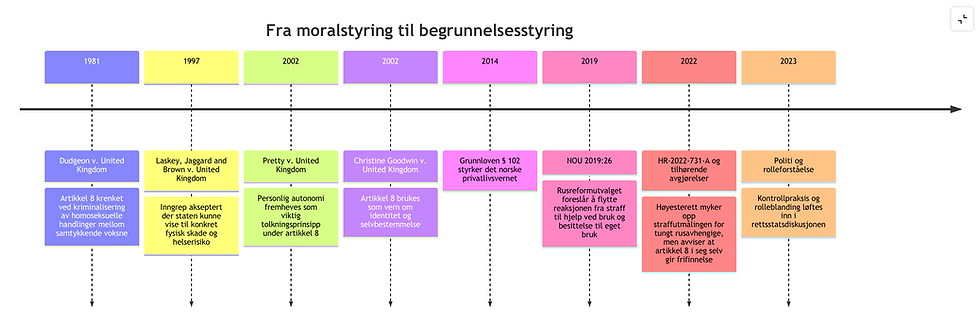
Kommentarer